
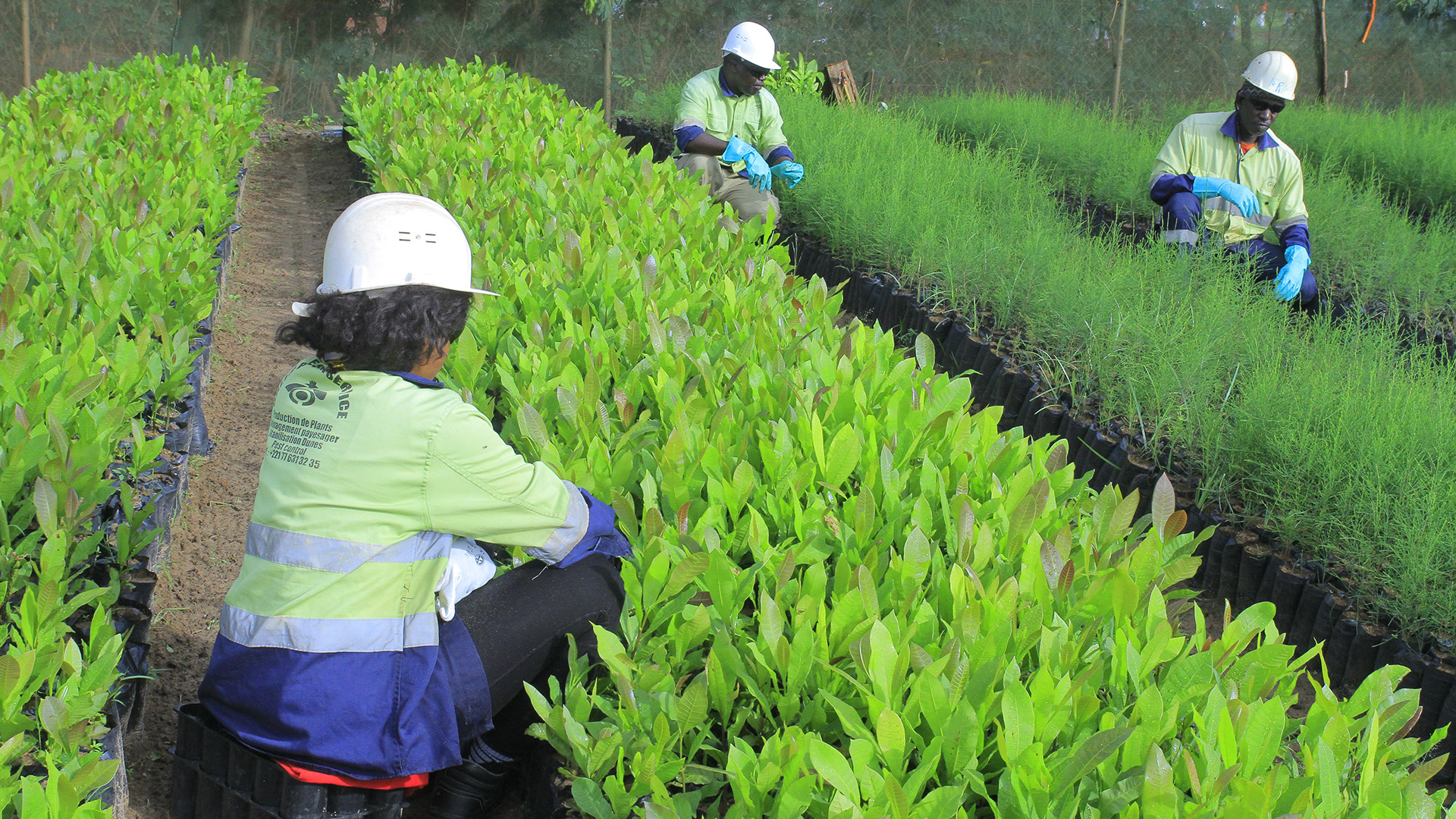
Eramet’s purpose is to become a reference for the responsible transformation of the Earth’s mineral resources for ‘living well’ together. In support of this purpose, preserving biodiversity is one of Eramet’s major objectives and is reflected in the Group’s “Act for Positive Mining” roadmap, which specifically calls for the integration of biodiversity preservation within all of Eramet’s activities.
Eramet’s joint initiative with the Lékédi Biodiversity Foundation is an example of such an initiative. The foundation manages the 14,000-hectare Lékédi Park in Gabon and is dedicated to Conserving biodiversity, rehabilitating orphaned primates, conducting scientific research and experimentation, sharing knowledge, and raising awareness. The team initiates and executes many such initiatives at our sites across the world, and is constantly looking for innovative projects to preserve biodiversity and strengthen the quality of rehabilitation.
We are always open to solutions for the themes outlined below:
Phytomining
What are we looking for
- Investigating the potential for Nickel (Ni) and Manganese (Mn) recovery through hyperaccumulator plants.
- We prefer solutions where these plants are used in fields such as cosmetics and medicine, offering added value beyond traditional metallurgy.
Solutions Not of Interest
- Applications without a clear recovery pathway that generates added value for communities.
- Projects lacking scientific basis, scalability potential, or measurable environmental and social benefits.
- Solutions that are purely theoretical and have not yet been validated at small scale or demonstrated in any adjacent application.
Note: Please include a non-confidential explanation of your solution when submitting.
Invasive Alien Species (IAS)
Invasive Alien Species (IAS) are a growing biodiversity concern across the globe. These species, encompassing animals, plants, and microorganisms, are introduced to ecosystems outside their native range through human activities. There are multiple ways through which they are introduced to Eramet’s sites.
For example:
- The movement of goods and materials through maritime, port, and overland routes – where for example, unexpected plants, animals and micro-organisms may be encountered as part of this travel.
- Movement and storage of soils and other organic matter – where for example, invasive alien plants or electric ants have been found before operations commence; and
- Through site closure and rehabilitation activities – where for example, reworked soils are exposed to the spread of IAS in the initial months and years.
What are we looking for
In 2024, Eramet launched an open innovation challenge on Invasive Alien Species and we see a gap in solutions for containing and controlling IAS.
- Contain IAS:
Solutions may look like biosecurity measures, novel physical or environmental barriers. - Control IAS:
Solutions may look like novel environmentally friendly biological sprays, targeted eradication strategies, or other mechanical/chemical treatment protocols.
Solutions could be applicable to sites in Gabon, New Caledonia, Argentina or Indonesia. Solutions proven in adjacent industries such as agriculture would be preferred.
Solutions Not of Interest
- Solutions that are not environmentally friendly.
- Solutions that are purely theoretical and have not yet been validated at small scale or demonstrated in any adjacent application.
Note: Please include a non-confidential explanation of your solution when submitting.